
About the Chester County Clerk of Courts
The Clerk of Courts is the criminal record keeper for the Chester County Court of Common Pleas. Caroline Bradley holds the office. Her staff handles roughly 5,000 to 6,000 criminal cases each year. The work covers the paperwork from arrest through sentence, and it does not stop there. The office also assesses the fines, costs, and restitution a court orders, then collects that money along with Probation, Parole and Pretrial Services. Clerks staff criminal, juvenile, and dependency hearings too.
One thing the office cannot do is give legal advice. The clerk files and keeps records. The clerk does not tell you what to file or how a law applies to your case. For that you need an attorney. The contact card below has the address, phone, and hours for the West Chester office.
Chester County Clerk of Courts
Clerk: Caroline Bradley
201 W. Market St., Suite 1400
West Chester, PA 19380
610-344-6135
Fax: 610-344-4465
Mon–Fri 8:30 AM–4:30 PM
How Chester County Splits Clerk Duties
Pennsylvania does not put all court records in one clerk's office. Chester County uses three. Each holds a different kind of case, and knowing the split saves you a wrong trip. The Clerk of Courts holds the criminal side. Civil and family filings go elsewhere, and so do wills and marriage licenses.
Here is who keeps what in the county. Match your case type to the right office before you call or visit.
- Clerk of Courts: criminal cases in the Court of Common Pleas, plus bail and criminal appeals.
- Prothonotary: civil suits, judgments, liens, and name changes. See the Prothonotary page for that office.
- Register of Wills and Clerk of Orphans' Court: wills, estates, guardianships, and marriage licenses.
So a criminal docket and a civil docket from the same person live in two separate offices. If you are tracking a lawsuit, head to the Prothonotary instead. For the full court structure, the Court of Common Pleas page lays out how the trial court is built.
What the Chester County Clerk of Courts Keeps
The office holds the paper trail of a criminal case from start to finish. A file can grow thick over the life of a case. The clerk records each step in order and keeps the documents that go with it. These records track the charges, the court's rulings, and what a defendant owes.
The main items the Clerk of Courts maintains include the following.
- Criminal informations, the prosecutor's formal charging papers.
- Docket sheets that list every event in date order.
- Bail entries and bond paperwork.
- Motions and the court's orders.
- Plea and sentencing records.
- Costs, fines, and restitution, with the running balance.
- Appeals and expungement or limited-access filings.
The office also assesses court costs and restitution and collects them with Probation, Parole and Pretrial Services. That collection role is why the clerk tracks the money owed on each docket, not just the case events.
How to Request a Certified Copy
A certified copy is a court-stamped document the office swears is a true copy of the original. People need them for many reasons. Sentencing orders, plea records, and case dispositions often must be certified to count in another court or with an agency. A plain printout from the online docket will not carry that weight. The steps below cover a request to the Chester County Clerk of Courts.
- Find the criminal docket number for the case. A Common Pleas criminal docket starts with CP-15-CR.
- Tell the clerk which document you need and how many certified copies you want.
- Submit the request in person at Suite 1400 or by mail, with the case details and your contact information.
- Pay the copy and certification fees by a method the office accepts.
- Pick up the copy or wait for it to come by mail.
Note: the Clerk of Courts cannot tell you which document you need for a legal purpose, so confirm that with your attorney first.
Records Request Fields for the Clerk of Courts
A clean request moves faster. Whether you write a letter or fill out a form at the counter, give the clerk enough to pull the right file the first time. The table below lists the fields a criminal records request should include and why each one helps.
| Field | Required | Notes |
|---|---|---|
| Criminal Docket Number | Helpful | CP-15-CR format; the fastest way to the file |
| Defendant Name | Yes | Full legal name; use the name as charged |
| Date of Birth | Helpful | Sorts out common names |
| Document Type | Yes | Docket sheet, order, sentence, plea, or disposition |
| Certified or Plain | Yes | Certified copies carry the court seal |
| Number of Copies | Yes | Each certified copy is charged |
| Requester Contact | Yes | Name, mailing address, and phone for return |
If you are missing the docket number, the office can search by name, though a date of birth narrows the result and cuts the search time.
Chester County Clerk of Courts Fees
Court copy and filing fees in Chester County follow the UJS and county fee schedules, and amounts change over time. Confirm the current charge with the office before you send payment. The office can give you the exact total for the documents you want.
Note: Copy and certification fees are set by court and county fee schedules and can change, so call the Clerk of Courts at 610-344-6135 to confirm the current amount before you pay.
Two points help you plan. First, certified copies cost more than plain copies, since the office adds a certification charge per document. Second, the clerk also collects the fines, costs, and restitution a court orders on a case, and those run on a separate balance from any copy fee. A search of the free online docket carries no fee at all.
How to Post Bail at the Chester County Clerk of Courts
Bail in a Common Pleas criminal case is posted with the Clerk of Courts during office hours. The clerk takes the payment and records the bond on the docket. After hours, you go to the prison instead, and the rules there differ. The steps below cover both paths.
- During the week, go to the Clerk of Courts at Suite 1400 between 8:30 AM and 4 PM, Monday through Friday.
- Pay by cash, certified check, money order, or credit card through the PAePay system.
- If the office is closed, call Chester County Prison first at 610-344-5040 before you go.
- At the prison, pay by PAePay credit card or by cash up to $9,500.
- Keep your receipt as proof that the bond was posted.
The cutoff at the clerk's counter is 4 PM, earlier than the 4:30 PM close, so leave time. The prison handles bail outside those windows, but the call ahead is required.
PACFile E-Filing Through the Clerk of Courts
Criminal case filings in Chester County can be submitted and received online through PACFile, the judiciary's e-filing system on the UJS Web Portal. Attorneys and self-represented filers use it to send eligible documents to the Clerk of Courts without a trip to the counter. The portal also delivers court notices back to the filer. You set up an account, then file against the right docket.
The portal where criminal filings start is shown below.
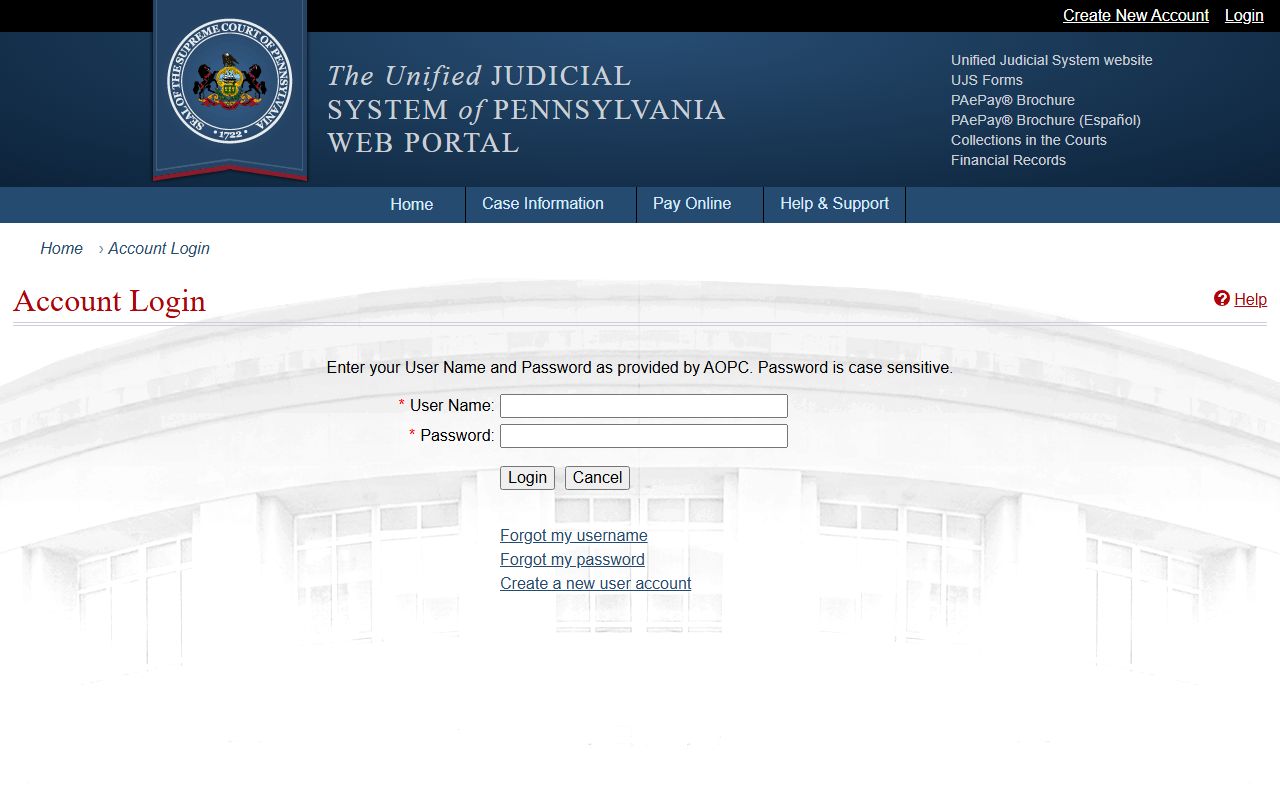
From the PACFile e-filing portal, a filer picks the case type, attaches the document, and pays any fee due. Paper filing at the office is still allowed for documents that are not eligible for e-filing.
Expungement and Clean Slate Filings
People who want to clear an eligible criminal record file with the Clerk of Courts in the county where the case was handled. Pennsylvania offers three separate remedies, and they are not the same thing. Expungement is the strongest. It can remove eligible criminal history information from public and agency records. Limited access hides a record from the public but keeps it open to criminal justice agencies. Clean Slate is automatic limited-access sealing once the statute's conditions are met.
The statutes set the rules. Expungement runs under 18 Pa.C.S. § 9122. Petition-based limited access runs under 18 Pa.C.S. § 9122.1. Clean Slate limited access runs under 18 Pa.C.S. § 9122.2, added by Act 56 of 2018. The Clerk of Courts warns that deciding whether you qualify is a legal question, so the office cannot advise on it and points people to the state judiciary's Clean Slate and expungement material.
A typical petition follows a set order.
- Identify the docket and pull the case disposition.
- Prepare the statewide petition and order forms from the UJS site.
- File with the Clerk of Courts in the county of arrest or conviction.
- Serve the District Attorney and any other required agency.
- Wait for objections, then attend a hearing if the court sets one.
The Chester County District Attorney is served on these petitions and may object before a judge rules. Common reasons a petition fails include an ineligible offense, unpaid costs or restitution, too short a waiting period, a new conviction, or an open case. For more on the criminal side, see arrest records.
Public Access to Criminal Records in Chester County
Most criminal files at the Clerk of Courts are open to the public. The office says all of its records are open except for a few protected groups. Juvenile and dependency cases are closed. Sealed and limited-access filings stay hidden, and the UJS payment portal will not even show or take payment on a limited-access case. Those limits exist to protect minors and people whose records have been shielded by law.
Anyone can read an open criminal docket. A few things are still cut from public view, though. The clerk redacts items like Social Security numbers, financial account numbers, and victim identifiers. A docket search is also not a background check. For a certified criminal history you use the Pennsylvania State Police, not a court docket. For the wider set of county court files, the court records page covers civil, family, and traffic cases as well.
Summary Appeals and Hearings
The Clerk of Courts also handles summary appeals that move up from the Magisterial District Courts to the Court of Common Pleas. A summary case is a minor offense, and a person found guilty before a district judge can appeal for a new hearing at the county level. The clerk dockets that appeal and tracks it through to its outcome.
Beyond appeals, the office staffs the criminal, juvenile, and dependency hearings that run in the courthouse. Clerks record what happens in court and update the docket so the file stays current. For the structure of the trial court that hears these matters, see the Court of Common Pleas.