
What Chester County Magisterial District Courts Do
The Magisterial District Court is the first level of judicial authority for most county residents. It is the court people meet most often. A speeding ticket, a small money claim, a fight over rent, or a first court date after an arrest all tend to land here. Chester County sits in the 15th Judicial District, so every district court number begins with 15. The Court of Common Pleas supervises the administrative side of these offices, but each district judge runs the daily docket.
These courts keep the system moving. They take in the high volume of minor cases so the larger trial court can focus on serious matters. A Magisterial District Judge can set bail, sign a search warrant, hold a preliminary hearing, and decide a summary case in full. They can also perform civil marriage ceremonies. The mix of duties is wide, and it touches both the civil and the criminal side of the law.
For larger cases that move up, see the Court of Common Pleas, which hears appeals from these district offices.
Jurisdiction of Chester County Magisterial District Courts
The reach of each district court is set by state rule, and it is broad at the low end of the system. On the civil side, a Magisterial District Court hears money claims up to $12,000. It also hears landlord and tenant cases up to that same $12,000 limit. On the criminal side, the court handles summary offenses, which are the lowest grade of crime. It takes the first steps in misdemeanor and felony cases too: setting bail, holding the preliminary arraignment, and running the preliminary hearing that decides if a case moves up.
Traffic is a large part of the work. Both summary traffic and non-traffic matters are decided here. A Magisterial District Judge can also sign search warrants and, as noted above, perform civil marriage ceremonies. The county's own overview lays out this list of duties.
The county overview page shows how these courts fit into the wider system and what they handle day to day.
You can view the official summary on the county's court system overview page.
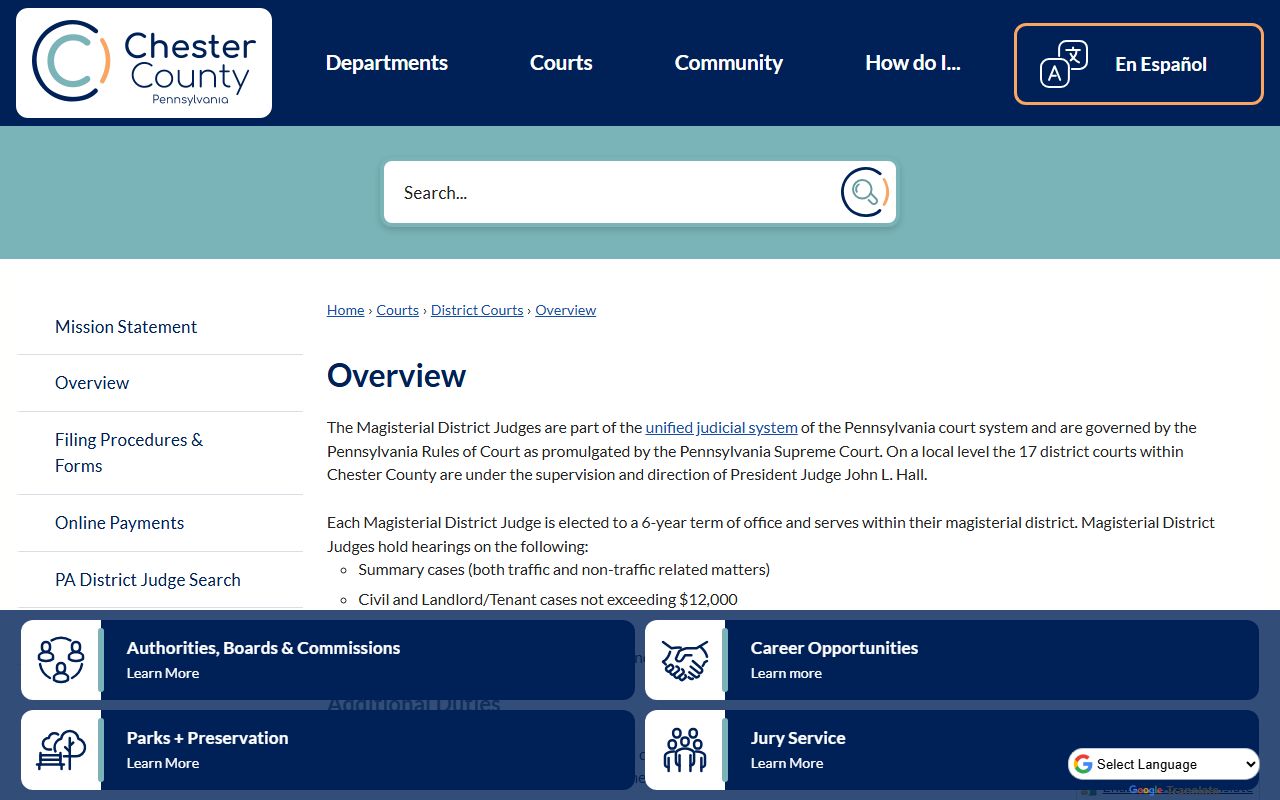
That overview groups civil, criminal, and traffic duties into one plain list, which is a quick way to confirm where a case belongs.
Note: the same $12,000 cap applies to both civil money claims and landlord-tenant cases, so a larger claim must start in a higher court.
Chester County Magisterial District Court Directory
The county has more than a dozen district offices, each tied to a set of municipalities. There is a small source conflict worth flagging: the county overview lists 17 district courts, while a District Attorney explainer says 16. The directory below reproduces the offices on record, with the judge, address, and phone for each. Find your town in the right-hand column to learn which court handles your case.
| Court # | Judge | Address | Phone | Municipalities |
|---|---|---|---|---|
| 15-1-01 | Marc Lieberman | 201 West Market Street, Suite 1307, West Chester, PA 19380 | 610-431-4814 | West Chester Borough, East and West Bradford |
| 15-1-02 | Vacant | 1572 Paoli Pike, West Chester, PA 19380 | 610-455-1100 | Malvern, East Goshen, Easttown, Willistown, parts of Tredyffrin and Westtown |
| 15-1-03 | Gregory Hines | One City Hall Place, Suite 200, Coatesville, PA 19320 | 610-455-1155 | Coatesville, South Coatesville |
| 15-1-04 | Marian T. Vito | 21 West Market Street, Suite 100, West Chester, PA 19382 | 610-344-6622 | West Chester wards 1, 2, 4, 5 |
| 15-2-01 | James C. Kovaleski | 347 Bridge Street, Phoenixville, PA 19460 | 610-455-1125 | Phoenixville, Charlestown, Schuylkill |
| 15-2-03 | Anthony DiFrancesca | 601 Westtown Road, Suite 110, West Chester, PA 19382 | 610-436-5757 | Thornbury, West Goshen, Westtown districts |
| 15-2-07 | N. Paige Simmons | 75 East Uwchlan Avenue, Suite 110, Exton, PA 19341 | 610-455-1140 | East Caln, West Pikeland, Upper Uwchlan, Uwchlan |
| 15-3-01 | John Hipple | 1101 Ridge Road, Suite B, Pottstown, PA 19465 | 610-455-1120 | Spring City, Coventry townships, East Pikeland, East Vincent, Warwick, more |
| 15-3-04 | Albert Iacocca | 916 West Cypress Street, Kennett Square, PA 19348 | 610-455-1170 | Kennett Square, East Marlborough, Kennett, Pennsbury, Pocopson, more |
| 15-3-05 | Scott A. Massey | 305 South Third Street, Oxford, PA 19363 | 610-455-1160 | Oxford Borough, East Nottingham, Elk, Lower Oxford, Penn, more |
| 15-3-06 | J. Timothy Arndt III | 4824 Horseshoe Pike, Honey Brook, PA 19344 | 610-455-1110 | Elverson, Honey Brook, Sadsbury, Wallace, West Brandywine, West Caln, more |
| 15-3-07 | Not listed in source | Not listed in source | 610-455-1115 | Atglen, Modena, Parkesburg, East Fallowfield, Highland, Valley, more |
| 15-4-01 | Lauren Holt | 950 West Valley Road, Suite 3100, Wayne, PA 19087 | 610-455-1130 | East Whiteland wards 3 to 6, Tredyffrin precincts |
| 15-4-02 | Ann Feldman | 231 Boot Road, Downingtown, PA 19335 | 610-455-1145 | Downingtown, Caln, East Brandywine |
| 15-4-03 | Erin Bruno | 748 Springdale Drive, Suite 110, Exton, PA 19341 | 610-455-1150 | East Whiteland wards 1 and 2, West Whiteland |
| 15-4-04 | Matthew Seavey | 914 West Cypress Street, Kennett Square, PA 19348 | 610-455-1175 | Avondale, West Grove, Franklin, London Grove, New Garden, more |
| District Justice Administration | Vicky Bartholomew | 201 West Market Street, Suite 4100, West Chester, PA 19380 | 610-344-6173 | Administrative office, fax 610-344-6522 |
The full set of offices, with hours and links, sits on the county's District Courts page. The District Justice and Minor Judiciary Administration office, run by Vicky Bartholomew at 201 West Market Street, Suite 4100, in West Chester, supports all of these districts and can be reached at 610-344-6173.
How Chester County Magisterial District Judges Are Chosen
A Magisterial District Judge is an elected official, not an appointed clerk. Voters in each district pick their judge, and the term runs six years. That long term gives the office some stability and keeps the judge close to the towns they serve. When a seat opens early, as the 15-1-02 listing shows, the office can sit vacant or be covered by another judge until the next election fills it.
These judges do not have to be lawyers in every case, but they must pass a state certification and keep up training. They hold real power over the start of a case. They set bail, decide summary matters, and rule on whether a felony or misdemeanor case has enough behind it to move up to the Court of Common Pleas.
The Statewide Network Behind the District Courts
Each Chester County Magisterial District Court office is tied into one statewide computer system. The Administrative Office of Pennsylvania Courts, known as the AOPC, runs this network. It links every district office so that case processing flows through a single system across the state. The network carries names, charges, fines and costs, payment records, and civil judgments. That shared backbone is why a docket filed in one district shows up in the same public portal as a case from any other county.
This setup helps the public too. Because the data lives in one place, you can search a Chester County district court docket from the same portal that serves the whole state. You can pull court dockets by name, by docket number, or by citation. Public access to these dockets is governed by the courts' own access policy.
The state's public access policy for case records explains what shows on a docket and what stays hidden.
The rule itself is published as the UJS public access policy at 204 Pa. Code § 213.81.
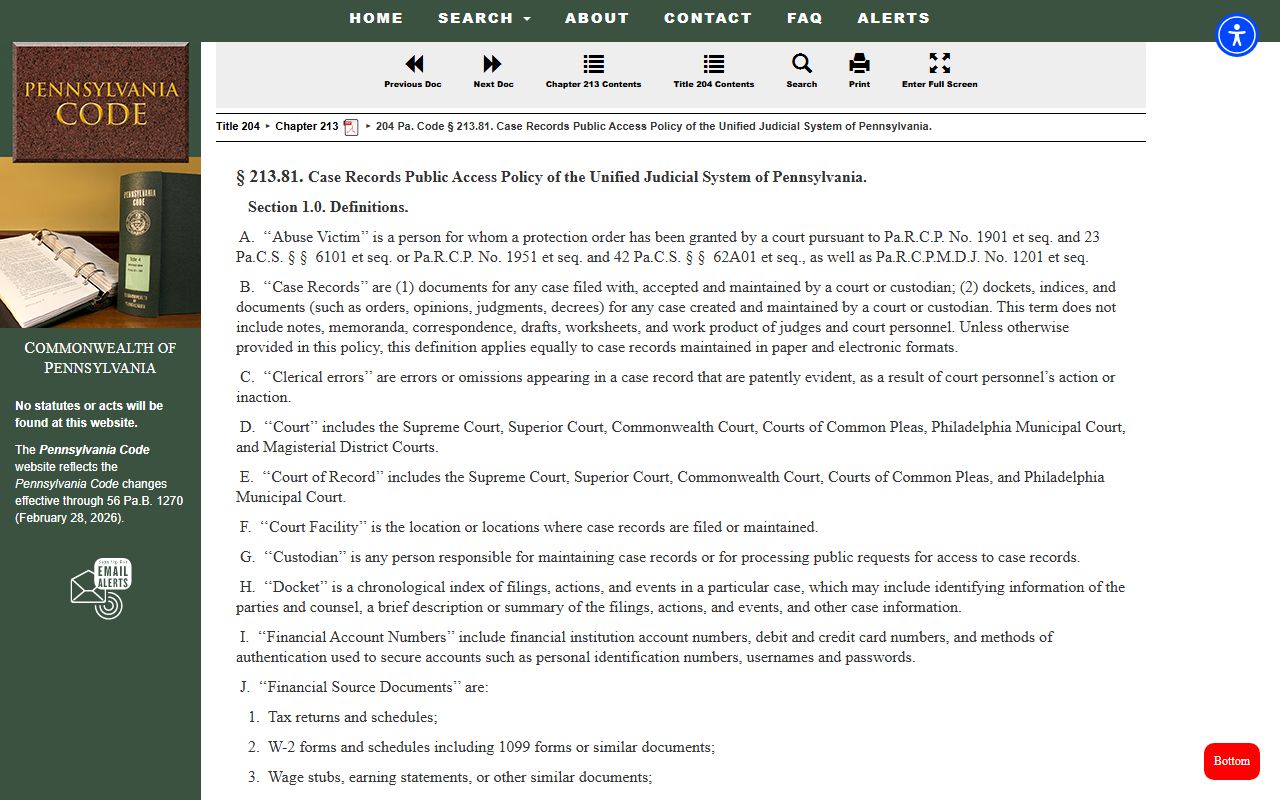
That policy sets the line between open docket data and the personal details that must be left off the public view.
Night Court and After-Hours Coverage
Court does not stop when the offices close. Chester County runs a Night Court rotation so a Magisterial District Judge stays on call after the Court of Common Pleas wraps up for the day. The rotation covers nights, weekends, and holidays. This matters most on the criminal side, where a fresh arrest needs a quick decision.
During these off hours the on-call judge can hold a preliminary arraignment and set bail. That means a person taken into custody does not have to wait for normal business hours to learn the charges and the conditions of release. The rotation spreads this duty across the county's judges so no single office carries it alone.
Paying a Chester County Magisterial District Court Case
Many district court cases end with a fine, court costs, or both. You do not always have to mail a check or drive to the office to pay. The state runs an online payment tool called PAePay through the court web portal. The portal's Pay Online menu lets you handle a traffic ticket or court costs, post bail, or pay state probation and parole fees. You select the case, add it to a cart, and pay by card.
PAePay does not cover every case. Limited-access and sealed cases are not payable online, and the system will not let you pay on them. For those, or for a payment plan, you deal with the district office directly. Traffic citations make up a big share of the payments that run through this tool, and you can read more about that on the traffic court records page.
| Pay Online Option | What It Covers |
|---|---|
| Traffic Ticket or Court Costs | Fines and costs on a payable citation or case |
| Bail | Posting bail on an eligible case |
| State Probation / Parole Fees | Supervision fees owed to the state |
Note: a sealed or limited-access case will not appear as payable, so a balance you cannot pay online may need a call to the district office.
Magisterial District Court vs. Court of Common Pleas
People often mix up the two trial courts, so it helps to lay them side by side. The district court is the small, local front door. The Court of Common Pleas is the larger, general-jurisdiction court for the whole 15th Judicial District. The table below shows the main splits between them.
| Feature | Magisterial District Court | Court of Common Pleas |
|---|---|---|
| Civil limit | Up to $12,000 | No dollar cap |
| Criminal role | Summary cases, bail, preliminary hearings | Full trials for misdemeanors and felonies |
| Traffic | Summary traffic and non-traffic | Appeals from the district court |
| Judge selection | Elected to six-year terms | Elected to ten-year terms |
| Offices | More than a dozen across the county | One courthouse in West Chester |
For the full profile of the higher court, including its judges and divisions, see the Court of Common Pleas page.
Appeals From Chester County Magisterial District Courts
If you lose a case at the district level, the case does not just end there. Summary, criminal, civil, and landlord-tenant matters decided by a Magisterial District Judge can be appealed to the Court of Common Pleas. The appeal follows state rules and local procedures, and the deadlines are short, so quick action matters. From there, a Common Pleas final order can move on to the Superior Court or the Commonwealth Court, depending on the subject.
The path is easier to see as a simple flow. Each step sends the case to a higher level for a fresh look.
- A case is filed and decided in a Magisterial District Court.
- An appeal goes to the Chester County Court of Common Pleas.
- A final Common Pleas order can be appealed to the Superior Court or Commonwealth Court.
- The Supreme Court of Pennsylvania may take discretionary review.
To trace a case as it climbs the system, you can follow the docket through the Chester County court records portal at every level.
Constables and the District Courts
Constables work alongside the Magisterial District Courts even though they are separate elected officers. A constable can serve court papers, transport defendants, and provide security on court days. When a district judge needs an order carried out, a constable is often the one who does it. Their fees and duties are set by state law, not by the court itself.
Constables are not the same as deputy sheriffs or local police. They fill a specific role in the lower courts and bill for the work they do. If a notice in your case mentions a constable, it usually means a paper was served or a court appearance must be enforced.