
Is There a Public Chester County Warrant Database
The short answer is no. The official Chester County sources do not publish a public, searchable active-warrant list or a sheriff "most wanted" page. There is no county portal where you can type a name and pull a live warrant. That fact trips up a lot of people who expect a quick online lookup. It also explains why so many third-party "warrant search" sites are unreliable. Those aggregators are not official, and the data they show is often stale or wrong.
The state court system does track warrants, but not for public use. The Pennsylvania Judiciary Web Portal lists statewide warrants as a secure service. Only approved court and law enforcement users can log in and view that data. The general public cannot. So a true Chester County warrant search has to work through other paths, which the sections below lay out.
Note: any site that claims to show a complete, live list of Chester County warrants for a fee is not an official source and should be treated with caution.
Who Issues and Enforces Chester County Warrants
Warrants come from judges, not from the police on their own. Magisterial District Judges in Chester County issue search warrants, set bail, and conduct preliminary arraignments. Common Pleas judges issue bench warrants in cases before them. A bench warrant can follow a failure to appear, contempt, or noncompliance with probation or support orders. Once a court signs a warrant, the job of serving it moves to law enforcement.
The Chester County Sheriff's Office handles warrant enforcement, fugitive apprehension, and court security. Sheriff Kevin D. Dykes commenced his term in December 2023. The office is a full-service law enforcement agency, and county records trace it back to 1676, when the first Sheriff was appointed. The official Sheriff page describes its core duties.
The image below shows that official page, which is the starting point for anyone confirming who runs warrant enforcement in the county.
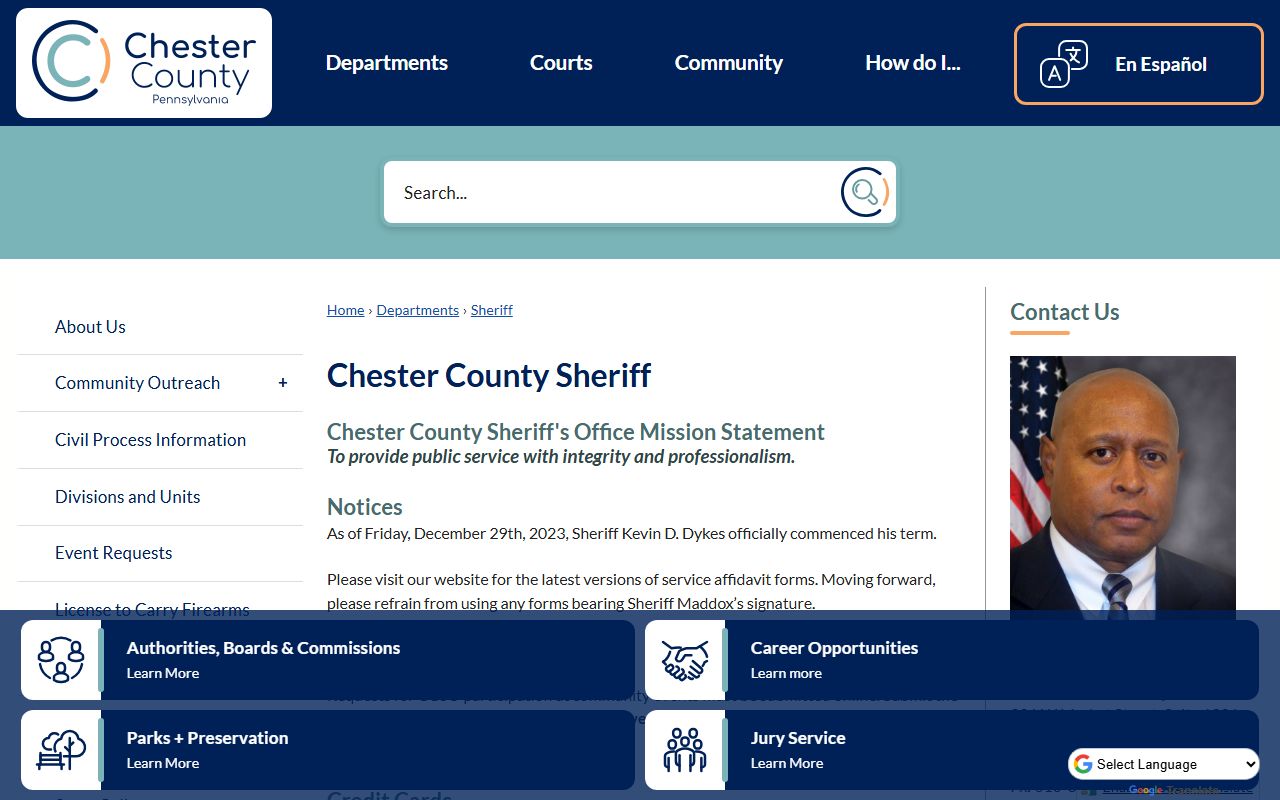
From that page you can find office contact details and the broader scope of the Sheriff's law enforcement work.
Types of Warrants in Chester County
Not every warrant works the same way. Some order an arrest. Some authorize a search. Some are a court's response to a missed date. Knowing the type helps you figure out which office issued it and how to resolve it. The list below covers the warrant types used in Chester County cases.
- Arrest warrant issued on a criminal complaint and probable cause, ordering that a person be taken into custody.
- Bench warrant issued by a judge for failure to appear, contempt, or probation or support noncompliance.
- Search warrant authorizing law enforcement to search a place or thing; Magisterial District Judges may issue these.
- Fugitive warrant or extradition hold for an out-of-county or out-of-state custody matter.
- Probation or parole detainer that holds a person based on a supervision violation.
- Domestic relations bench warrant tied to support or contempt nonappearance.
- Sealed warrant that stays out of public view until it is executed or unsealed.
A domestic relations case can produce a bench warrant on its own. The county's Domestic Relations office warns that a failure to appear may result in an order against the party or a bench warrant.
How to Search Chester County Warrants
Since no public county warrant list exists, a Chester County warrant search works best through court dockets and direct phone contact. The free Pennsylvania Judiciary Web Portal does not show a standalone warrant list, but its public docket sheets often record warrant events once a case is filed. A docket may note when a warrant was issued, served, or withdrawn. If you are checking on a case, that is usually the fastest public path.
- Identify the issuing court from any paperwork, citation, or notice you already have.
- Open the UJS public docket search and look up the case by name, docket number, or OTN, and set the county to Chester.
- Read the docket entries for warrant-related events such as issuance, service, or withdrawal.
- If you cannot confirm a warrant online, call the issuing Magisterial District Court, the Clerk of Courts, or the Sheriff's Office.
The secure statewide warrant database stays closed to the public, so phone verification with the issuing court is often the only way to confirm a warrant that has not yet hit a public docket. For broader case history tied to a warrant, the Chester County court records page explains how the docket portal works.
Chester County Warrant Search Fields
There is no single county form with name and date-of-birth fields for warrants, because no public warrant portal exists. Instead, a warrant search is a mix of methods, and each one has its own access rules. The table below maps the realistic paths and what each one requires.
| Field Label | Type | Required | Notes |
|---|---|---|---|
| Public Chester warrant search | n/a | n/a | No official public county warrant list located |
| UJS secure statewide warrants | Secure login | Yes | Approved court and law enforcement users only; not public |
| UJS public docket | Web search | Optional | Search by participant, docket, or OTN; may show public warrant events |
| Court phone verification | Phone | Yes if concerned | Contact the issuing Magisterial District Judge, Clerk of Courts, or Sheriff |
Pick the path that matches what you know. A docket search fits a known case, while a phone call fits a warrant you only suspect exists.
What a Chester County Warrant Record Shows
Because there is no public warrant list, the closest thing to a warrant record the public can see is the warrant event on a UJS docket sheet. Those entries appear inside a case file, not as a freestanding warrant. The field inventory below reflects the docket fields tied to a warrant, drawn from how UJS dockets are built.
| Field | What It Shows |
|---|---|
| Docket Number | The case ID and court, which links the warrant to a specific matter |
| Court | The Common Pleas court or Magisterial District Court that issued it |
| Charge | The offense or claim behind the case |
| Warrant Event | The docket note of issuance, service, or withdrawal |
| Issue / Serve / Withdraw Date | When the warrant was issued, served, or lifted |
| Bail | Any bail set in the case, where listed |
| Next Proceeding | The upcoming hearing or court date |
These fields tell you a warrant existed and what happened to it, but they do not stand in for a certified record. For that, you contact the court that holds the file.
How Chester County Warrant and Criminal Information Is Released
Warrant data does not flow freely the way many public records do. The information sits inside criminal case files, and those are governed by rules on criminal history. In Pennsylvania, the release of criminal history record information is controlled by the Criminal History Record Information Act, found at 18 Pa.C.S. Chapter 91. That law sets who may receive criminal record data and for what purpose. It is the reason a docket search is not the same as a background check.
You can read the full text of that chapter on the official legislature site, shown below.
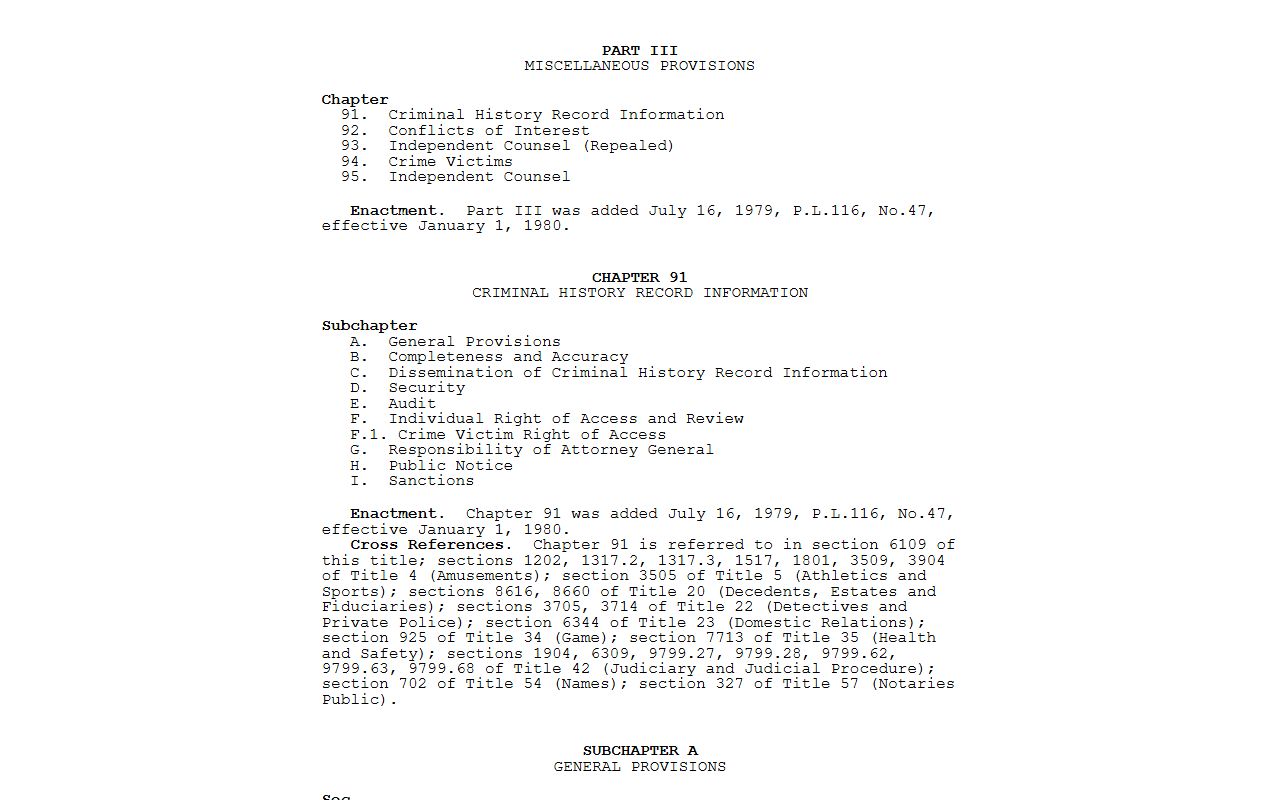
The statute, posted at 18 Pa.C.S. Chapter 91, frames how agencies handle and share the criminal data that warrants are part of. For the arrest side of a case, the criminal records page covers how charges and bookings become public.
How to Resolve a Chester County Warrant
If you think a warrant is out for you, do not ignore it. Ignoring court dates is one of the most common ways a bench warrant gets issued in the first place. The steps below follow the process the county's own bail and court pages describe, from confirming the warrant to getting written proof it was lifted.
- Identify the issuing court from your paperwork, a UJS docket, a citation, or a notice.
- Contact an attorney, or apply to the Public Defender if the case is criminal and you cannot afford counsel; apply at least two business days before a court date when possible.
- Call the issuing Magisterial District Judge or the Clerk of Courts to confirm the procedure, any required appearance, and the bail or payment rules.
- Keep every court date. A failure to appear can trigger a new bench warrant.
- If bail is set in Common Pleas, post it at the Clerk of Courts in Suite 1400, 610-344-6135, Monday to Friday 8:30 AM to 4 PM, by cash, certified check, money order, or PAePay card. After hours, call the Chester County Prison first at 610-344-5040; the prison accepts a PAePay card and cash up to $9,500.
- Get written proof of the warrant lift, a bail receipt, or a new court date before you leave.
Important: Talk to a lawyer before you turn yourself in on a warrant; counsel can confirm the warrant, explain bail, and protect your rights at the hearing.
Posting Bail on a Chester County Warrant
Many warrants resolve when bail is posted and a court date is set or kept. Where you post depends on the court and the time of day. Common Pleas bail goes to the Clerk of Courts during business hours. After the office closes, the prison handles it, with a phone call first. Magisterial District Judges set bail for the cases they handle and run preliminary arraignments.
The Sheriff's Office also accepts credit cards for several in-person services, including bail transport, license-to-carry permits, fingerprinting, and notary service. Knowing the right counter and payment method ahead of time saves a wasted trip. For more on the office that processes criminal bail and filings, see the Clerk of Courts page.
Warning About Warrant and Ticket Scams
Scammers use the fear of a warrant to pressure people into paying. The Pennsylvania courts have warned the public about a text-message scam that spoofs PA Courts and UJS. The fake text claims you owe an unpaid traffic ticket and pushes you to a scam URL to pay right away. Real courts do not collect warrant or ticket payments through a random text link.
If you get a message like that, do not click. Verify any claimed warrant or unpaid ticket directly with the issuing court, the Clerk of Courts, or the Sheriff's Office using a phone number you look up yourself. A short call to confirm beats handing money to a fraud. When in doubt, treat any unexpected demand for fast online payment as suspicious.
Restricted Chester County Warrant Records
Some warrants and the cases behind them are not open to the public at all. A sealed warrant stays hidden until it is executed or a court unseals it. Juvenile matters are confidential, and that confidentiality extends to warrants connected to them. Pennsylvania restricts juvenile records under the Juvenile Act at 42 Pa.C.S. Section 6307, and the Chester County Clerk of Courts treats juvenile and dependency cases as exceptions to public access.
The juvenile records statute is posted on the official legislature site, shown here.
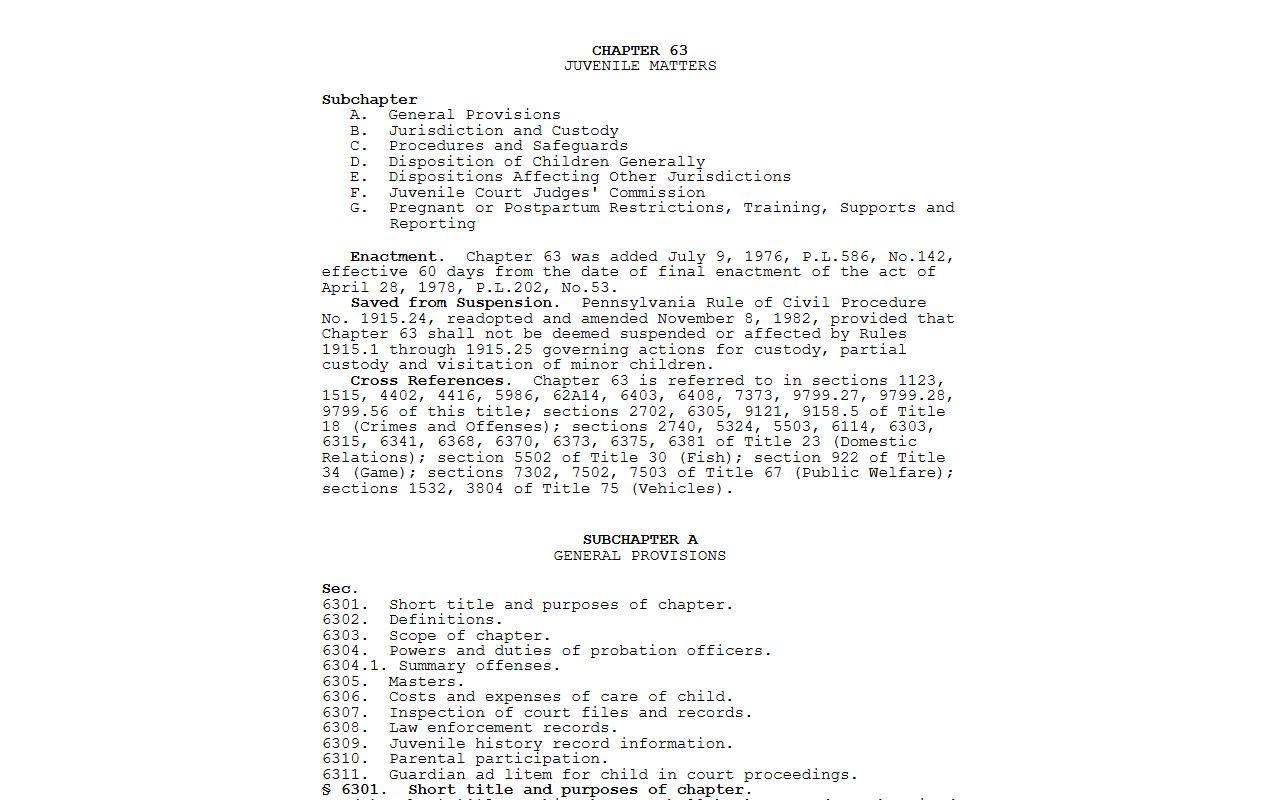
You can read that section, 42 Pa.C.S. Section 6307, to see why a juvenile warrant will not appear in a public search. Federal warrants are another category, since federal cases run through the federal court system and not the county. Once a person is booked into custody, the inmate records page explains how to confirm where they are held.
Related Public-Safety Registries
A warrant search is not the only public-safety lookup people reach for. Pennsylvania runs a separate, fully public registry for registered sex offenders. That tool is the State Police Megan's Law site, and it is unrelated to warrants. It lists registrants who meet the statutory criteria, with profile details the public can view by name or area.
The Pennsylvania Megan's Law registry is shown below as a distinct public lookup, separate from any warrant or jail-release search.
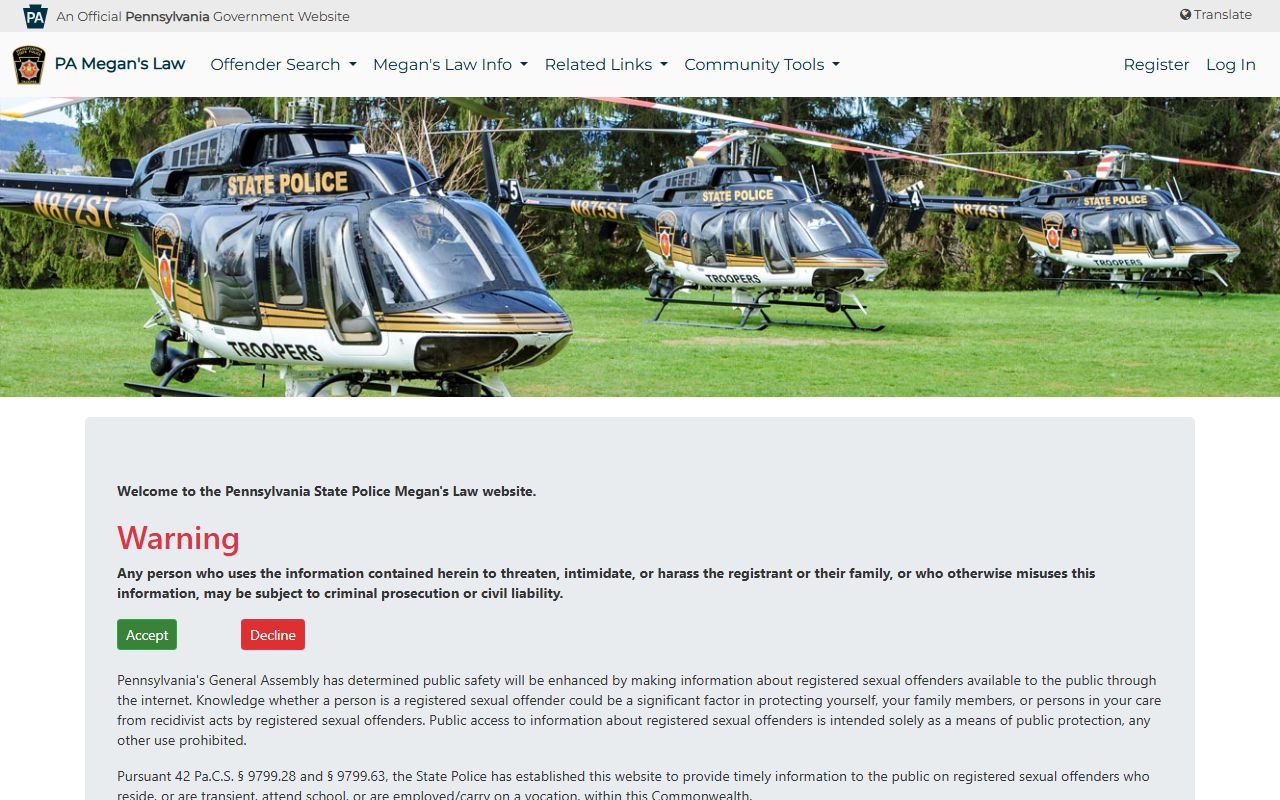
Keep in mind that the registry is not a criminal-record or warrant database. It only covers offenders required to register, so it should never stand in for a full court search.